


Sewing Thread
Why Choose Us
Customizable
We offer a wide range of thread colors, types, and sizes, allowing our clients to choose the thread that best meets their needs.
High-quality products
We are committed to producing the highest quality embroidery thread, quilting thread, and other sewing products. We use only the best materials and the latest manufacturing processes to ensure our products are of the highest quality.
Fast delivery
We know that our customers rely on us for timely delivery, and we pride ourselves on our ability to deliver orders quickly and efficiently.
Wide product range
They offer a broad range of embroidery threads, including viscose, polyester, rayon, metallic, and specialty threads like glow-in-the-dark and water-soluble threads.
What is Sewing Thread?
Sewing thread is a type of thread used for sewing fabrics together. It is made of various materials such as cotton, polyester, silk, nylon, and rayon. Sewing threads are available in different thicknesses, colors, and finishes to suit different fabrics and sewing purposes. They are used for machine sewing, hand sewing, embroidery, quilting, and more. Sewing threads play a crucial role in the strength, durability, and appearance of the garment or project being sewn.


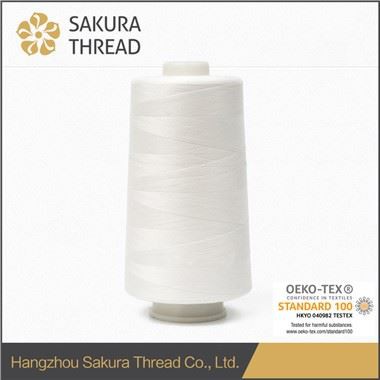


Advantages Of Sewing Thread
Strength: Sewing threads are designed to be strong enough to hold the fabrics together without breaking.
Durability: Good quality threads are resistant to wear and tear, making them last longer.
Variety: There are various types of sewing threads available in the market like cotton, polyester, nylon, silk, and metallic, which can be used for different types of fabrics and purposes.
Color: Sewing threads are available in a wide range of colors, making it easy to match them with the fabric color.
Convenience: Sewing threads are easy to use and come in spools that can be easily stored.
Cost-effective: Sewing threads are relatively inexpensive, making them an affordable option for sewing enthusiasts.
Compatibility: Sewing threads are compatible with a wide range of sewing machines, making them a versatile option.
Ease of Use: Sewing threads are easy to handle and manipulate, making it easy to create intricate designs and patterns.
Adaptable: Sewing threads can be adapted to different thicknesses and strengths, depending on the requirements of the fabric and the project.
Creativity: Sewing threads offer a great scope for creativity, as they can be used to create intricate designs, patterns, and embroidery, adding a unique touch to the fabric.
The Different Important Properties Required By a Sewing Thread Are Discussed


●Needle thread must pass freely through the small eye of the needle; consequently they must be uniform, knot-free, non-torque and fault free.
●Tensile strength/breaking strength is one of the essential properties of the thread. It must be capable of withstanding several kinetic/lateral movements during sewing. The strength of the sewing thread must be higher than that of the fabric so that the thread does not rupture during use. During sewing at high speeds, the needle thread is subjected to repeated tensile stresses at very high rates. The thread also comes under the influence of heat, bending, pressures, torsion and wearing. The value of these stresses depends on the sewing speed, machine settings and the thread used. The stresses created within the thread have a negative effect on the processing and functional characteristics of the thread, and there is significant reduction in the thread strength after sewing.
●For good performance in a sewing machine moderate to low extension-at-break of the thread is usually preferred. Needle thread with different elongation-at-break has been found to behave quite differently during stitch formation. The determinants of success of sewing a thread with certain elongation per cent without any problem the machine setting and special properties of the sewing thread itself.
●The elasticity of the sewing thread must be uniform along its length in order to enable equal length stitches to be formed, and it must closely match the elasticity of the fabric being sewn; otherwise either seam thread fracture, or tearing of the adjacent fabric may arise during garment use. Clearly, the requirements of woven and knitted fabrics will be different.
●The forces that are developed in the sewing thread are mostly due to the friction between the thread and machine parts, the most severe action taking place between:
The thread and the needle.
The thread and the fabric being sewn.
A controlled level of both static and dynamic friction is required; this must not be too high, which could cause lack of thread control. High static friction values are necessary to allow the stitches to lock and prevent “run-back” of seams. Spun threads are particularly good in this respect when compared with filament thread. The worst is the monofilament threads. The frictional properties are affected by lubrication. The factors that influence the frictional properties are:
Uniform application of lubricating agents.
Adhesion of the finishing agent on the thread.
The quantity and quality of finishes are very important. Special finishes like silicone compounds have been found to exhibit clear advantage over standard paraffin wax.
●Good abrasion resistance is essential for good sewing performance. The thread is under tension condition, especially when the stitch is being set. The thread must be resilient enough to return to shape after the distortions, and then must maintain its physical properties to provide good performance in the seam after the sewing process is complete. Nylon and polyester offer the best resistance to abrasion.
●Good resistance to heat is a very important requirement of a sewing thread. The temperature reached by the sewing needle during sewing very much depends on:
The nature of the fabric to be sewn (density, thickness, finish)
The speed of the sewing machine
The type of needle used (size, shape, surface finish)
Size and finish of the sewing thread.
The needle temperature is especially critical for fabrics and sewing threads of thermoplastic fibers, where it may exceed their melting temperature. Needle heating causes sewing thread breakage, cross-thread, skipped stitches, seam damage and physical damage to the needle.
●The hairiness of sewing thread also affects the appearance of the seam. Sewing threads for decorative seams are singed, squeezed and gloss-brushed.
●The final direction of twist insertion may be important to enable the stitch forming mechanism of the sewing machine to perform correctly; most sewing machine require Z twist, but there are a few where performance is better with S twist.
●Color fastness is a general requirement for sewing thread. It is important that the selected shade retain its color throughout the life of the garment. Two aspects of fastness are important:
The thread must not change color.
The thread must not stain any material adjacent to the seam.
●Low shrinkage during washing and ironing is required. Shrinkage due to fiber swelling causes seams to pucker, especially if the fabric exhibits less shrinkage than threads. Synthetic threads suffer less from this problem than cotton threads owing to their much lower moisture absorbency; however they are liable to residual shrinkage problems if unsuitable manufacturing processes are employed. Synthetic threads can suffer from the problem of thermal shrinkage during ironing but this difficulty can be solved by the use of high temperature setting, which stabilizes the thread at temperature above those normally encountered during the ironing process.
Properties Of Sewing Thread
Good tensile strength:To grip the seam firmly during wear and wash. The tensile strength should be higher than that of the fabric so that it won’t rupture during the stretch at the seams. Also, it would mean minimum thread breakage during sewing.
Higher initial modulus: Of thread guarantees the minimum of thread deformation during shock loading while sewing in the machine. The sewing thread should be moderately stiff to form the loops for stitch formation
Smooth surface: Without any abnormalities in the thread results in a minimum of friction between the needle and sewing thread while sewing at high speed.
Uniform thickness: Of the sewing thread provides for smooth passage of the thread through the needle and the fabric. Also, it causes less movement of the thread while passing through the machine.
Good elasticity: Facilitates the thread to recover its original length instantly after the tension has been released. It should be similar to that of the fabric being sewn, thus the requirement for woven and knitted fabric will be different. Also, it greatly influences the strength and quality of the stitched seam.
Good color fastness: Of the thread makes it resistant to the various chemical and physical agents the thread is exposed to during manufacturing and during its useful life specially during washing, perspiration, sublimation, etc. This ensures no bleeding of the color into the garment. Also, it should be dyed evenly and uniformly.
Lower shrinkage characteristics: Of the thread are very important as it can cause a critical defect in the garment in the form of puckering at the seams. Cotton thread usually undergoes washing shrinkage while synthetic thread suffers from thermal shrinkage during ironing.
Better chemical resistance:As the sewing thread may be subjected to various chemicals during washing, bleaching, dry cleaning, etc.
Higher abrasion resistance : Provides a good sewing performance and makes the thread more durable meaning it would return to its original shape after the tension is removed maintaining its physical properties. Nylon and polyester offer the best resistance to abrasion.

Sewing thread is a trim which ensures the functional properties of a garment or any clothing product by securing the seams. It is a special type of yarn which is used for sewing but not for knitting or weaving.
It can be made of staple fibre or continuous filaments by twisting hardly or slightly. Two or more filament yarns are twisted together to make threads. Sometimes single filament is also used. Natural or synthetic or blended fibres can be used to make sewing threads.
For over locking or cover stitch seams continuous bulk filament threads are perfect. For high quality denim garment, natural and synthetic fibre blended core spun threads are perfect for closing seams. For achieving perfect seam strength for leather goods, continuous filament threads are perfect.
●All purpose thread:Made of polyester, cotton, or a combination of the two, this medium weight thread is suitable for most sewing projects in fabrics ranging from light to medium-heavy weights. Mercerized cotton all purpose thread will have more of a sheen to it than plain cotton thread.
●Heavy duty all purpose thread:Use this for heavy weight fabrics – like upholstery fabric. I also like to use it as a topstitching thread on things like jeans
●Machine embroidery thread: Made of viscose or rayon, machine embroidery thread is thinner and lighter weight and is used for machine embroidery. It also often has more of a sheen than all purpose thread.
●Elastic thread : Used for shirring
●Invisible thread:Like thin fishing line. This is a monofilament thread for sewing sequins and specialty uses, not general use.
●Serger cone thread :This lightweight thread is similar to all purpose polyester, but thinner

Our Factory
Our Group has passed the certifications of ISO9001:2008 quality management system and ISO14001:2004 environment management system. Furthermore, threads produced by us have Oeko-Tex-Standard 100 and Intertek certificates. "Sakura" brand threads are exported to Europe, the USA, Southeast Asia and South Africa. Those products are reliable in environmental protection and quality, and open the world market. They will bring you prosperity and great wealth.


